
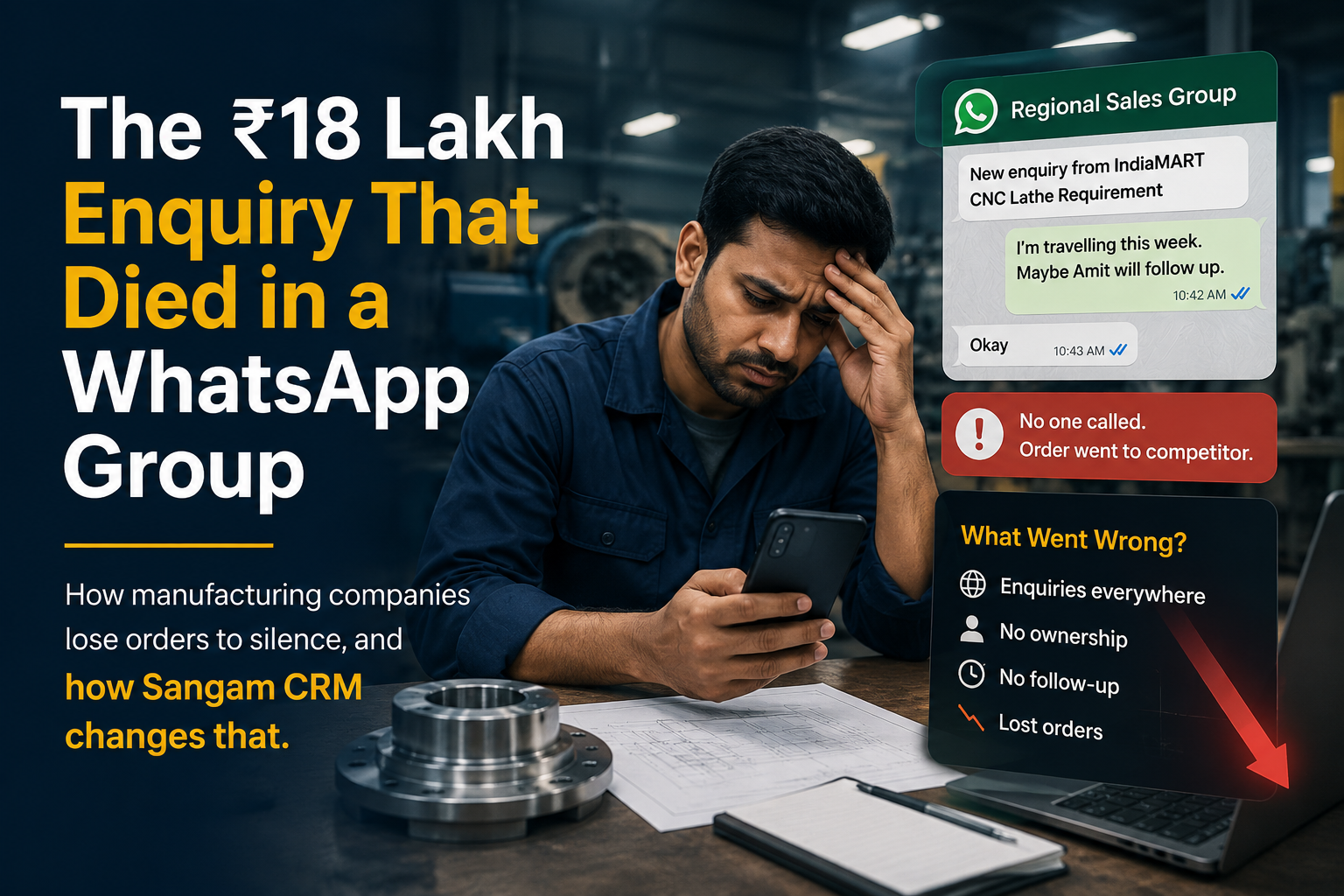
The ₹18 Lakh Enquiry That Died in a WhatsApp Group
A machine tools manufacturer in Vadodara once told me something I still repeat to clients. He said his company doesn’t lose orders to competitors. It loses them to silence.
He wasn’t being dramatic. Here’s what had happened. An enquiry came in through IndiaMART for a mid-size CNC lathe. The office executive forwarded it to the regional sales WhatsApp group. The salesperson for that territory was travelling that week, saw the message, thought his colleague would handle it, and moved on. Nobody called. Eleven days later the buyer placed the order with a competitor in Rajkot.
Nobody was lazy. Nobody was incompetent. The enquiry simply had no home. It lived in a WhatsApp group, which is another way of saying it lived nowhere.
If you run a manufacturing business in India — machinery, fabrication, chemicals, packaging, auto components, industrial equipment, solar — you have your own version of this story. Maybe it’s a quotation that went out with last year’s pricing. Maybe it’s an AMC that lapsed because nobody tracked the renewal date. Maybe it’s a salesperson who resigned and walked out with three years of customer relationships stored in his personal phone.
This article is about one specific answer to that problem: Sangam CRM, and what it does for manufacturing companies. I’ll go through where it fits, where it doesn’t, and what implementation actually looks like — not the brochure version.
Why Generic CRMs Fail in Manufacturing
Most CRM software is built with a software company or an insurance agency in mind. Lead comes in, demo happens, deal closes, subscription renews. Clean and linear.
Manufacturing does not work like that.
Your sales cycle isn’t weeks. It’s quarters. A capital equipment enquiry can take eight to eighteen months from first call to purchase order. There are site visits, sample approvals, trial runs, technical validations, three rounds of price negotiation, and a purchase committee that includes someone who has never met your salesperson. A CRM designed around a 21-day pipeline can’t hold that.
Your quotation is a technical document, not a price list. It carries specifications, material grades, delivery timelines, payment terms, warranty clauses, freight and insurance conditions, and GST breakups. It gets revised four or five times. Each revision needs to be traceable, because six months later somebody will ask which version the customer actually approved.
Selling is only half the relationship. The order is where your work starts. Installation, commissioning, operator training, warranty complaints, spare parts, preventive maintenance, AMC renewal. A CRM that stops at “Deal Won” abandons you at the exact moment your customer needs you most.
You sell through people you don’t employ. Dealers, distributors, channel partners, freelance agents. Their enquiries and their performance need to sit in the same system as your direct sales, or you’re managing two businesses with one balance sheet.
Your team isn’t at a desk. Your sales engineers are at customer plants. Your service technicians are on the road. If the CRM only works properly on a laptop, adoption dies in week two.
This is the gap Sangam CRM targets.
What Is Sangam CRM?
Sangam CRM is a business CRM platform from Enjay IT Solutions, an Indian company that has been working with SMB and mid-market businesses for years. It’s built around four working areas — sales, marketing, service or helpdesk, and internal task management — and it’s offered with industry-specific configurations rather than as one generic product. Manufacturing is one of its core verticals, alongside IT, wealth management, debt collection, hospitality, and chartered accountancy practices.
Two things separate it from the global CRM names most Indian manufacturers evaluate first.
It’s built for Indian business reality. Tally integration, GST-compliant quotation formats, IndiaMART and TradeIndia lead capture, WhatsApp workflows, dealer and distributor structures, INR pricing without dollar-conversion shock. These aren’t add-ons here, they’re assumed.
Pricing is all-inclusive. With several international CRMs, the licence fee is the starting number. Hosting, storage, support tiers, sandbox environments and implementation partners get billed separately, and the actual cost lands well above the sticker. Sangam CRM’s commercial model bundles the platform and its support in one figure, which makes budgeting far simpler for a 15-person company.
A note on pricing: Sangam CRM works on a “price on request” model that varies with user count and module scope, so I’m not going to quote a number that would be wrong for your situation. Ask for a quotation based on your actual user count.
Six Manufacturing Problems Sangam CRM Actually Solves
1. Enquiries Coming From Everywhere
Count your enquiry sources honestly. IndiaMART. TradeIndia. JustDial. The contact form on your website. The generic sales@ mailbox. Exhibition visiting cards sitting in a drawer since the last trade fair. Direct calls to the owner’s mobile. Referrals from existing customers. Dealer submissions.
Eight sources, zero single view.
Sangam CRM connects to the platforms Indian manufacturers actually use — IndiaMART, TradeIndia, JustDial, your website, email — and pulls enquiries into one queue. From there, assignment rules route each enquiry to the right person based on territory or product line, and the clock starts. If the enquiry isn’t touched within your defined window, it escalates.
That one change — every enquiry has an owner and a deadline — usually delivers the fastest visible return of the entire project. Not because of any clever algorithm, but because things stop falling through gaps.
2. Quotation Chaos and the “Final_Final_v6” Problem
Open your shared drive and search for quotations. I already know what you’ll find: Quote_Sharma_Industries_final.xlsx, Quote_Sharma_Industries_final_revised.xlsx, and Quote_Sharma_Industries_FINAL_USE_THIS.xlsx.
Quotation management is where Sangam CRM earns its place in a manufacturing setup. You build quotations inside the CRM from a maintained product and price master, so nobody quotes from a stale sheet. Revision history is preserved, which means every version is retrievable with its date and its author. Approval workflows can be enforced, so a discount past a threshold routes to you before it reaches the customer instead of after.
And because Sangam CRM integrates with Tally, an approved quotation can carry forward into invoicing without your accounts team retyping line items and inviting typos into your books.
For manufacturers with complex terms — and every manufacturer has complex terms — quotation templates can be configured by type. Choose the quotation category and the correct clause set, delivery terms and warranty language populate automatically. Your sales engineer stops writing legal language from memory at 9 PM.
3. Long Sales Cycles and Follow-Ups That Slip
An eleven-month sales cycle has roughly thirty touchpoints. Human memory manages maybe six of them reliably.
Sangam CRM handles the pipeline in stages you define — Enquiry, Qualified, Technical Discussion, Sample Submitted, Quotation Sent, Negotiation, PO Expected, Won or Lost — rather than forcing a software-sales pipeline onto a capital-goods business. Every activity is logged against the customer record, not the salesperson’s memory. Follow-up reminders fire on schedule. Mobile access means a sales engineer can log the visit outcome from the customer’s parking lot instead of “updating it tomorrow”, which we both know means never.
The underrated benefit is continuity. When a salesperson resigns — and in Indian manufacturing sales, they resign every two or three years — the entire history stays with you. The replacement reads six months of context in twenty minutes instead of calling the customer and asking them to explain their own requirement again.
4. Managing Dealers and Distributors
If a meaningful share of your revenue comes through channel partners, you already know the pain of asking twelve dealers for their monthly numbers over WhatsApp and getting nine replies in four different formats.
Sangam CRM’s sales projection and reporting lets you cut performance by salesperson, by product, by area, and by distributor. That’s the combination that matters. It answers the questions manufacturers genuinely ask: which dealer is growing and which is coasting, which product moves in Maharashtra but not in Gujarat, which territory is under-covered, which partner needs a scheme and which needs a conversation.
Once dealer enquiries flow into the same pipeline, your forecast stops being a feeling and starts being a number you’d be willing to defend to your banker.
5. After-Sales: Installation, Complaints, Spares, AMC
This is where Sangam CRM is noticeably stronger than most sales-only CRM tools, and it’s the reason I recommend it for equipment manufacturers in particular.
Installation tracking. Schedule technician visits, track installation status from despatch through commissioning, and see which jobs are pending against which order.
Complaint and ticket management. Customer complaints come in as tickets, get auto-assigned — including to the nearest available executive, which matters when you have field staff spread across a state — and escalate if they age past your SLA.
Spare parts requests. Raise and track spare part requests inside the CRM. Over a few months, the request data tells you which parts to pre-stock, which quietly shortens your delivery promises.
Contract and AMC management. Contracts are managed centrally from start to renewal. Preventive maintenance tickets can generate automatically against the schedule, so PM visits happen because the system raised them, not because someone remembered.
That last point deserves emphasis. AMC and spares revenue is high-margin and predictable, and most MSME manufacturers under-collect it purely because renewal tracking sits in a spreadsheet nobody opens. Automated renewal reminders often pay for the CRM by themselves.
6. The Owner’s Blind Spot
Ask most manufacturing owners what’s in the pipeline for next quarter and you’ll get a number sourced from optimism.
With activity, quotations and stage movement recorded in one place, Sangam CRM’s dashboards give you the real picture: enquiry volume by source, conversion rate by stage, quotations pending decision, average deal size, win-loss patterns, individual and team performance. You can see where deals die. If 60% of your losses happen after quotation submission, that’s a pricing or a follow-up problem, and you now have evidence instead of a theory.
Sangam CRM also supports user-level data restrictions and masking of customer email and phone details, which is genuinely useful when you have contract sales staff or a large team and don’t want your entire customer database walking out of the building.
Sangam CRM Features Checklist for Manufacturers
| Requirement | What Sangam CRM provides |
|---|---|
| Multi-source enquiry capture | IndiaMART, TradeIndia, JustDial, website, email |
| Lead assignment and escalation | Rule-based routing by territory or product, ageing alerts |
| Quotation management | Product master, revision history, approval workflow, format templates |
| Invoicing | Quotation-to-invoice via Tally integration |
| Long-cycle pipeline | Custom stages, activity logging, follow-up scheduling |
| Channel management | Distributor-wise, area-wise, product-wise sales reporting |
| Installation | Technician scheduling and installation status tracking |
| Service | Ticket management, nearest-executive auto-allocation, escalation |
| Spares | Spare part request raising and tracking |
| AMC | Contract lifecycle management with auto-generated PM tickets |
| Field usability | Web and mobile app with real-time updates |
| Data security | User-specific access restrictions, email and phone masking |
| Extensibility | API access, Zapier and Pabbly, Google Workspace, WhatsApp, telephony |
Integrations That Matter in an Indian Factory
Integration lists are usually padded. These are the four that change daily work.
Tally. Your accounts run on Tally. If the CRM can’t talk to it, someone re-enters every approved quotation by hand. Sangam CRM’s Tally integration removes that step and the errors that come with it.
WhatsApp. Your customers don’t check email. They reply on WhatsApp within four minutes. Quotation sharing and follow-up over WhatsApp isn’t a nice-to-have in Indian B2B, it’s the primary channel.
Telephony. Sangam CRM connects with Indian cloud telephony providers, which gives you call logging against customer records and call recordings for training and dispute resolution. If you’ve ever had a customer insist they were promised a delivery date that nobody remembers promising, you understand the value.
Marketplaces. IndiaMART and TradeIndia enquiries landing directly in the CRM, timestamped and assigned. Given what those platforms cost per lead, letting enquiries sit unattended in an inbox is expensive in a very literal way.
Who Sangam CRM Is Right For — and Who It Isn’t
Honest section, because a bad-fit CRM sale helps nobody.
Good fit if you are:
- An MSME or mid-market manufacturer with roughly 5 to 100 sales, service and support users
- Selling machinery, equipment, components, chemicals, packaging, industrial products or project-based solutions
- Running a service and AMC operation alongside sales
- Selling through dealers or distributors in multiple states
- Already using Tally and needing the CRM to work with it
- Frustrated by international CRM pricing where hosting and support arrive as separate invoices
Probably not the right fit if you are:
- A large enterprise needing deep, native ERP and MES integration across plants — you’re likely in SAP or Dynamics territory
- A pure B2C manufacturer selling through retail and e-commerce with no field sales function
- Looking for shop-floor production planning, inventory or MRP — a CRM manages customers, not production scheduling, and no CRM should be sold to you as an ERP replacement
- Unwilling to assign an internal owner to the project, because then no CRM will work, and that’s not a product problem
Implementation Is Where Most CRM Projects Die
I’ll say this plainly, having implemented CRM for manufacturing companies across India: the software is rarely the reason a CRM project fails.
Failure looks like this. The company buys licences. Someone in IT sets up basic fields over a weekend. Sales staff get a one-hour training session on a Friday afternoon. Nobody defines what a “qualified lead” means for this business. Within three weeks, half the team is back in Excel and the owner concludes CRM doesn’t work for manufacturing.
What works instead:
Map the process before touching the software. Your enquiry-to-order flow, your approval thresholds, your quotation terms, your service SLAs. Configure to that reality, not to a default template.
Start narrow. Sales pipeline and quotations in phase one. Service, AMC and spares in phase two. Dealer management in phase three. Teams that get all modules on day one use none of them.
Get the masters right. Product master, price list, terms library, customer data cleanup. Boring, unglamorous, and the single biggest predictor of whether adoption sticks.
Make it the only source of truth. If the owner still accepts a pipeline update over WhatsApp, the CRM is optional, and optional systems are abandoned. Review the pipeline from the dashboard in the sales meeting. Once. That’s usually all it takes.
Train by role. A field sales engineer needs fifteen minutes on mobile logging. A service coordinator needs an hour on ticketing. Same training session for both wastes everyone’s time.
Enjay backs Sangam CRM with structured onboarding, certification-style training courses and periodic CRM usage audits, and honestly, that support layer matters more than any single feature comparison. Most CRMs have similar feature lists. The difference between a CRM that runs your business in month six and one that’s abandoned is almost entirely implementation quality.
What Change Looks Like After 90 Days
Not projections. Patterns I’ve seen repeat across manufacturing implementations.
Month 1. Uncomfortable. Data entry feels like extra work. Some resistance, usually from your senior-most salesperson, who has managed fine in his head for fifteen years. Expect it and don’t over-react.
Month 2. Enquiry response time drops sharply, because unassigned enquiries no longer exist. Quotations go out faster because nobody rebuilds them from scratch. The first “we would have lost that one” moment happens, and it converts a sceptic.
Month 3. The pipeline number starts being believable. Follow-up gaps become visible and therefore fixable. AMC renewals that would have lapsed get caught. The sales review meeting shortens by half because nobody is reciting updates that are already on screen.
One manufacturing case study from Enjay’s own library makes the point well. A CNC machine tool manufacturer in Vadodara had been running stock on a custom application and managing sales in Excel. After moving to Sangam CRM, their data consolidated into a single system, reporting became something they could pull weekly or monthly on demand instead of assembling manually, and their heavily conditional quotation formats were configured to generate automatically by quotation type.
That last detail is the sort of thing brochures skip and manufacturers care about deeply.
Frequently Asked Questions
Is Sangam CRM suitable for small manufacturing companies?
Yes. It’s built primarily for SMB and mid-market businesses, and implementations commonly start in the 5 to 20 user range. Small manufacturers often see returns faster than large ones, simply because the gap between “everything in Excel and WhatsApp” and a structured system is wider.
Does Sangam CRM integrate with Tally?
Yes. Tally integration lets you generate invoices from approved quotations without re-entering data, which is one of the more practically valuable integrations for Indian manufacturers. Confirm the specifics for your Tally version during your demo.
Can Sangam CRM replace our ERP?
No, and be cautious of anyone who says otherwise. A CRM manages customers, enquiries, quotations, orders and service. An ERP manages production planning, inventory, purchase and finance. They complement each other. Many manufacturers run Sangam CRM on the customer-facing side and Tally or an ERP on the operational side.
How does Sangam CRM handle quotation revisions?
Quotations are created in the CRM with revision history preserved, so every version is retrievable with its date and author. Approval mechanisms can be set so that discounts beyond a defined limit need sign-off before the quotation leaves.
Is there a mobile app for field sales and service teams?
Yes, Sangam CRM works on both web and mobile, with real-time updates and notifications. For manufacturing teams that spend most of their week at customer sites, this is what determines whether adoption survives past the first month.
How long does a Sangam CRM implementation take?
A focused sales-and-quotation rollout for a small team typically runs a few weeks. Multi-module implementations covering service, AMC, spares and dealer management take longer. The variable is rarely the software — it’s how quickly your team can finalise process decisions and clean up master data.
What does Sangam CRM cost?
Pricing is quoted on request and depends on user count and modules. What’s worth checking during evaluation is what’s included. Several international CRMs quote a licence fee and then bill hosting, support and implementation separately; Sangam CRM’s model is designed to be all-inclusive, which usually makes the total cost of ownership easier to predict.
Can we manage dealers and distributors in Sangam CRM?
Yes. Sales performance can be analysed distributor-wise, area-wise, product-wise and salesperson-wise, which lets you evaluate channel partner performance in the same system as your direct sales.
What about after-sales service and AMC?
This is one of the stronger areas for manufacturing users. Sangam CRM covers ticket management with auto-allocation and escalation, installation scheduling, spare part requests, and contract management with automatically generated preventive maintenance tickets so AMC visits and renewals don’t get missed.
Our sales team resists new software. Will they use this?
Some resistance is guaranteed. It reduces sharply when three conditions are met: mobile entry is fast, the CRM visibly saves them work — usually via quotation generation — and management stops accepting updates through any other channel. Adoption is a management decision more than a software feature.
Can Sangam CRM capture leads from IndiaMART and our website?
Yes. It connects with IndiaMART, TradeIndia, JustDial and website forms, so enquiries arrive in one queue with a timestamp and an owner instead of scattering across inboxes and WhatsApp groups.
Is our customer data secure?
Sangam CRM supports user-specific access restrictions and masking of customer email and phone details, so team members see only what their role requires. For manufacturers with contract sales staff or high turnover, that’s a meaningful protection.
Conclusion
Most Indian manufacturers don’t have a sales problem. They have a memory problem.
The enquiries arrive. The products are competitive. The relationships are real, often built over two decades. What breaks is the connective tissue — the follow-up that nobody made, the quotation revision nobody could find, the AMC renewal nobody tracked, the dealer whose declining numbers nobody noticed until the year ended.
Sangam CRM works for manufacturing because it was designed for how manufacturing actually sells: long cycles, technical quotations, dealer networks, and a service relationship that runs for years after the invoice is paid. Add Tally integration, WhatsApp workflows, marketplace lead capture and INR-sensible pricing, and it fits an Indian factory considerably better than a global CRM you’d spend six months bending into shape.
But choose your implementation partner as carefully as you choose the software. Feature lists across CRM products look broadly similar on a comparison page. What separates a CRM that runs your business from a CRM that gets abandoned is whether someone understood your enquiry-to-order process before configuring anything.
If you’re evaluating Sangam CRM for your manufacturing business, start with one honest question: where exactly do enquiries stop moving in your company right now? Answer that with specifics, and you’ll know precisely what to test in the demo.
Technofet is a certified Sangam CRM implementation partner working with manufacturers across India, with 65+ CRM implementations delivered. If you’d like to see how Sangam CRM would map to your enquiry-to-order process, book a discovery call and we’ll walk through your current workflow before we show you a single screen.