
Your Real Competitor Isn’t Another CRM
When we started implementing CRM for solar business clients in Gujarat, I assumed we’d be competing against Zoho or some other CRM product. That assumption was wrong within about two meetings.
Almost no solar company owner we’ve spoken to is comparing CRM software. He isn’t sitting in his office weighing feature matrices. He’s running his entire business on WhatsApp and Excel, and he’s doing it reasonably well until the month he crosses roughly fifteen simultaneous installations. Then it stops working, and it stops working all at once.
Here’s what that owner is actually thinking about on a Tuesday afternoon:
- Which site is delayed, and does the customer know yet
- Which final payment hasn’t come in after commissioning
- Which customer called about an inverter fault last week and never got a callback
- Which enquiry his salesperson forgot to follow up on
Four questions. He can’t answer any of them without making six phone calls. That’s the problem. Not software.
This article covers what a CRM for solar companies actually needs to handle — lead through survey, quotation, project, net metering, payment and service — and what we learned configuring Sangam CRM for a solar client in Gujarat. I’ll also be straight about what it doesn’t solve.
Why a Generic CRM Fails in the Solar Industry
Solar isn’t manufacturing and it isn’t a typical project business. It has its own specific failure points, and understanding them is the difference between a CRM that gets used and one that gets abandoned in month two.
The sale doesn’t end at the sale. In most businesses, closing the deal means handing off to operations and moving on. In solar, the moment a customer says yes, a project begins that will run for weeks — material procurement, structure fabrication, panel installation, inverter commissioning, DISCOM application, net meter installation, subsidy documentation. Your salesperson stays involved throughout, because the customer keeps calling him, not your operations coordinator.
Money arrives in pieces. Advance on booking, a payment against material delivery, a payment on installation, final payment after commissioning or net meter approval. Four milestones per project. Fifteen live projects means sixty payment events to track, each with its own due date and its own excuse for delay. This is where solar companies quietly bleed working capital.
Your team is never in the office. Survey engineers at rooftops. Installation crews on site. Service technicians driving between complaints. If you can’t verify that a team actually reached a site — and reached it at the time they claimed — you’re managing on trust alone across a whole district.
Approvals depend on people you don’t control. DISCOM applications, net metering approval, subsidy portal processing. These sit outside your company entirely, and they’re the single most common reason a customer gets angry at you for something that isn’t your fault. Without a record of what was submitted and when, you can’t even defend yourself.
Not every lead deserves a site visit. A survey costs you a half day of an engineer’s time and fuel. Sending someone to a rooftop that turns out to be shadowed, structurally unsuitable or too small to be viable is pure loss. Qualification has to happen on the phone, and it has to be specific.
What Is Sangam CRM?
Sangam CRM is a business CRM platform from Enjay IT Solutions, built for Indian SMB and mid-market companies. It covers sales, service and helpdesk, marketing, and internal task management, and it’s offered with industry-specific configurations rather than as a single generic product.
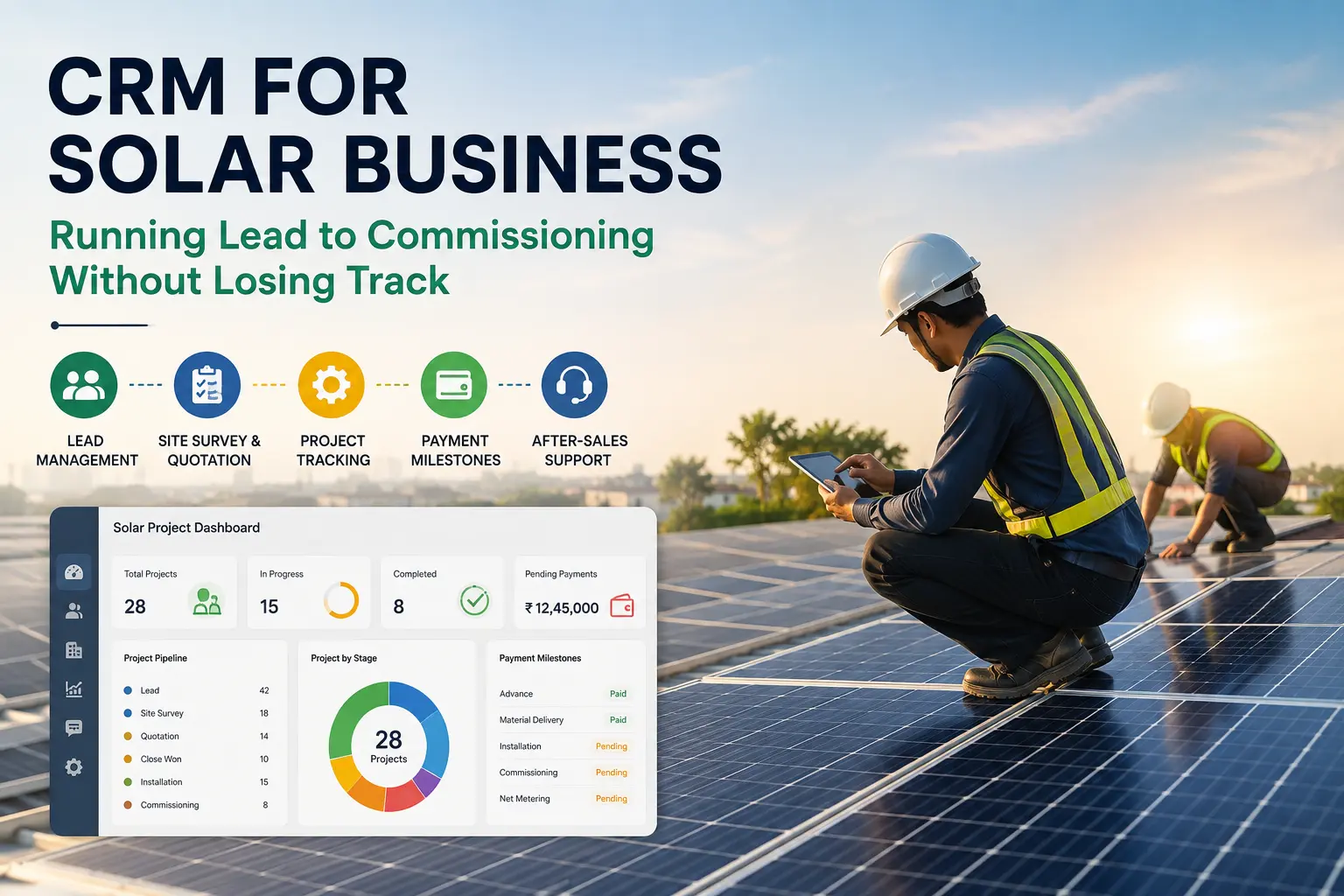
For solar, what matters is that it isn’t only a sales pipeline tool. A useful CRM for solar business operations has to survive past close-won, and this one does — the platform includes project management, task assignment, payment tracking, field activity capture and ticket management. That means the full lead-to-commissioning chain lives in one system rather than being split across a CRM for sales and spreadsheets for everything after.
Two practical points for Indian solar businesses. It’s built around Indian business reality — Tally integration, WhatsApp workflows, IndiaMART and website lead capture, INR pricing. And its commercial model is all-inclusive rather than the international pattern where licence, hosting, support and implementation arrive as separate invoices. Pricing is quoted on request based on user count and modules, so I won’t put a number here that would be wrong for your situation.
The Solar Workflow, Stage by Stage
This is the section worth reading closely, because it’s drawn from an actual configuration rather than a feature list. The full chain runs: Lead → Opportunity → Quotation → Project → Project Tasks → Payment Details → Tickets.
1. Lead Capture With Fields That Actually Qualify
Standard CRM lead fields — name, phone, city, source — tell you nothing useful about a solar enquiry. You still have to call and ask everything.
The lead form we configured captures the things that determine whether a project is viable before anyone drives anywhere:
- Roof type — RCC, sheet metal, tiled. This changes your structure cost immediately.
- Shadow issues — a water tank, a neighbouring building, trees. Shadow can kill a project outright or force a panel layout that changes the economics.
- Available square footage — determines maximum system size and whether the enquiry matches the capacity the customer thinks he wants.
- Project type — residential, commercial, industrial. Different pricing, different subsidy eligibility, different sales cycle, often a different salesperson.
Four fields, captured during the first phone call. Your survey engineer now goes only to sites worth going to, and he arrives already knowing what he’s walking into.
Leads flow in from IndiaMART, your website form, WhatsApp enquiries and direct calls, land in one queue, and get assigned by territory. Nothing sits in a group chat waiting for someone to notice it.
2. Site Survey Scheduling
Converting a lead to an opportunity triggers survey scheduling. The visit is assigned to an engineer with a date, and it appears on his task list rather than in a WhatsApp message he’ll scroll past.
The survey outcome comes back into the same record. If the enquiry dies at survey stage — roof unsuitable, customer wanted a price you can’t meet, shadow worse than described — that reason is captured as a lost reason rather than disappearing. Three months of lost-reason data tells you something useful: if 40% of your surveys die on price, your quoting is wrong. If they die on shadow, your phone qualification is weak. You can’t fix what you never recorded.
3. Quotation and Close-Won
Quotations are built inside the CRM from a maintained product and price master, with revision history preserved. Solar pricing moves — module prices, inverter brands, structure steel rates — and quoting from a three-month-old Excel file is how margin disappears without anyone noticing.
The important configuration is what happens at close-won. In our solar setup, marking an opportunity as won automatically creates the project record and assigns the payment schedule. Not a manual handover. Not a coordinator copying details into a new sheet. The project exists the moment the deal closes, with the customer data and system specification already attached.
That single automation removes the most common failure point in solar operations: the gap between “customer said yes” and “operations knows about it,” which in a WhatsApp-and-Excel business is routinely three to five days.
4. Project Stages: Material to Net Metering
The project moves through defined stages rather than living in someone’s head. The sequence we configured tracks material readiness, structure work, installation, commissioning, DISCOM and net metering, and final documentation.
Each stage carries tasks, an owner and a status. Status changes drive auto-assignment, so when material readiness is marked complete, the installation task appears for the right team without anyone coordinating it by phone.
The net metering and documentation stages deserve particular attention, because they’re where solar companies get blamed for delays that belong to the DISCOM. When the application date, submission status and approval date are recorded against the project, you can tell an angry customer exactly what was filed and when. That conversation goes very differently when you have a date instead of an apology.
5. Field Team Check-In With GPS and Photo Proof
This is the module solar owners react to most strongly in demos, and it’s the one that has the least to do with traditional CRM.
Field teams check in and out at each site. The check-in captures GPS location, photos, video and a digital customer signature, and generates an activity log automatically against that project.
What this gives you in practice:
- Confirmation that the team actually reached the site, and when
- Photographic record of installation condition, useful months later during a warranty dispute
- Customer signature at completion, which is your proof when final payment is being delayed on the claim that work is incomplete
- An honest picture of how much of the day your crews spend travelling versus working
Attendance management sits alongside this, which for a company with fifteen or twenty field staff spread across a state removes a genuinely tedious daily headache.
6. Payment Milestones and Outstanding Amounts
Payment details attach to the project with milestone-based scheduling. The dashboard shows advance amount, amount received, outstanding balance and days overdue, calculated automatically rather than maintained by hand.
For the finance person, this replaces the weekly ritual of calling every project coordinator to ask what’s been collected. For the owner, it answers the question that actually keeps him awake: how much money is sitting uncollected right now, and against which sites.
We also configured salesperson incentive calculation off the payment data, since in most solar companies incentive is tied to collection rather than booking. That removed a monthly argument that used to consume half a day.
7. After-Sales Tickets
A solar installation carries a relationship that runs for years — inverter faults, generation dropping below expectation, panel cleaning, warranty claims, AMC.
Complaints come in as tickets, get assigned with escalation if they age, and track on-site time so you know what service is actually costing you. Over a year, ticket data tells you which inverter brand is generating your service load, which is a procurement decision worth having evidence for.
The commercial angle is worth stating plainly. Service and AMC revenue in solar is high-margin and predictable, and most installers under-collect it purely because nobody tracks renewals. That’s not a strategy problem, it’s a spreadsheet problem.
The Four Questions Every Solar Owner Asks Daily
Back to the four questions from the opening. Here’s where each one gets answered once everything sits in one system.
| The question | Where the answer lives |
|---|---|
| Which site is delayed? | Project stage view — sites stuck at a stage past expected duration |
| Which payment hasn’t come? | Payment dashboard — outstanding amount and days overdue per project |
| Which customer complained and got no response? | Ticket list — open tickets by age with escalation flags |
| Which lead was forgotten? | Lead queue — unassigned or untouched enquiries past your response window |
Not four dashboards. One screen, four sections. That’s the entire value proposition, and everything above is machinery in service of it.
CRM for Solar Business: Configuration Checklist
If you’re evaluating a CRM for solar business use, this is what the configuration should cover. Use it as a demo checklist and make the vendor show you each row.
| Stage | What needs to be configured |
|---|---|
| Lead | Roof type, shadow issues, square footage, project type, source, territory-based assignment |
| Opportunity | Survey scheduling, survey outcome capture, lost reason list specific to solar |
| Quotation | Product and price master, revision history, approval limits, system specification |
| Close-won | Auto project creation, auto payment schedule assignment |
| Project | Material readiness, structure, installation, commissioning, DISCOM and net metering, documentation |
| Tasks | Status-based auto-assignment, owner and due date per task |
| Field | GPS check-in and check-out, photo and video capture, digital signature, auto activity log |
| Payments | Milestone schedule, received and outstanding auto-calculation, overdue days, incentive calculation |
| Service | Ticket creation, assignment and escalation, on-site time tracking, AMC tracking |
| People | Attendance, user-level data access restrictions |
| Owner view | Single dashboard covering delayed sites, outstanding payments, open tickets, stale leads |
Let’s Be Honest About the Word “Automation”
This section exists because we got this wrong early and it cost us a deal.
When you tell an Indian SMB owner that a system is “automated,” a good number of them hear zero human input. They picture the software filling itself in. Then during onboarding they discover their team has to enter roof type and shadow details and payment receipts, and they feel misled. The objection is always some version of: this is extra work for my team.
The honest answer is yes, it is data entry. Somebody has to type the roof type. Nobody is pretending otherwise.
But look at what your team does today. Your coordinator maintains a project sheet. Your accountant maintains a payment sheet. Your salesperson maintains a follow-up list on his phone. Three people entering overlapping data into three files that disagree with each other by Thursday. That is also work — it’s just work that produces nothing you can look at.
The gain isn’t less typing. It’s that after the typing, nobody has to remember anything. As one owner put it to us in Gujarati, the point is that yaad nahi rakhna padega — you won’t have to hold it all in your head. The system raises the follow-up, flags the overdue payment, escalates the stale ticket.
If a CRM vendor tells you their system requires no data entry, ask them where the data comes from. Then watch them explain.
Who This Fits — and Who It Doesn’t
There’s no single best CRM for solar business operations — it depends entirely on your project volume and whether you need post-sale tracking or only a sales pipeline. Here’s an honest read on fit.
Good fit if you are:
- A solar EPC or installation company handling roughly 5 to 50 projects a month
- Running a team of 5 to 50 across sales, survey, installation, service and accounts
- Doing residential, commercial or industrial rooftop, or a mix
- Currently managing on WhatsApp groups and Excel and feeling it break
- Losing visibility specifically on payment collection or project delays
- Running field teams you can’t physically supervise
Probably not the right fit if you are:
- A one or two person operation doing two projects a month — you don’t have a memory problem yet, and a CRM will feel like overhead
- A utility-scale or ground-mount developer with multi-crore project financing and land acquisition workflows — that’s project management software territory, not CRM
- A module or inverter manufacturer rather than an installer — your workflow is manufacturing, and the manufacturing configuration fits better
- Looking for design and engineering tools — a CRM won’t do shadow analysis, string sizing or generation modelling, and shouldn’t claim to
- Unwilling to assign one internal person to own the rollout, in which case no CRM will work and the software isn’t the reason
Which Is the Best CRM for Solar Business in India?
This is the question everyone types into Google, and every article answering it has an obvious problem: the answer is always whatever the author sells. So let me give you the version that’s actually useful.
There isn’t a best CRM for solar business in India. There’s a best fit for your project volume, your team structure, and how much of your business happens after the deal closes. Those three things vary enormously between a four-person residential installer in Rajkot and a thirty-person commercial EPC running projects across three states.
What separates the options is one question: does the software stop at the pipeline, or does it continue through the project?
Generic sales CRMs
Zoho, HubSpot, Freshsales and similar platforms manage leads, deals and follow-ups well. They’re mature, affordable at entry level, and easy to start with.
The limitation for solar is structural rather than a missing feature. They’re built around a deal that closes and ends. Your installation, DISCOM application, net metering and four payment milestones happen after that point, and the software has no opinion about any of it. You’ll either build project tracking through heavy customisation and maintain it yourself, or you’ll keep a parallel spreadsheet — which is the situation you were trying to leave.
Reasonable choice if: your bottleneck is genuinely lead follow-up, your project volume is low, and operations coordination isn’t yet painful.
Enterprise platforms
Salesforce and Microsoft Dynamics can be configured to do anything, including everything in this article. The cost is time and money — months of implementation, an admin who knows the platform, and a total cost that lands in lakhs per year before you count the partner.
Reasonable choice if: you’re a large developer with dedicated IT capacity and multi-state operations. For a solar company under fifty people, you’re buying architecture for a scale you don’t have, and complexity is the main reason CRMs get abandoned.
Solar-specific and project-capable CRMs
Platforms that continue past close-won into project stages, field activity and payment milestones. Sangam CRM sits here when configured for solar — the lead-to-commissioning chain, GPS check-in, milestone payments and service tickets all in one system.
Reasonable choice if: your problems are operational rather than purely sales — delayed sites, uncollected payments, unverifiable field visits, service complaints with no record.
Free tiers and spreadsheets
Worth saying plainly: if you’re doing two or three projects a month, Excel and a WhatsApp group are genuinely adequate, and buying software now means paying for a problem you don’t have yet. The breaking point is usually somewhere between ten and fifteen simultaneous installations. Below that, spend the money on marketing instead.
How to actually decide
Skip the feature comparison. Ask each vendor these four questions and the shortlist collapses quickly:
- “What happens in your system after I mark a deal as won?” If the answer is nothing, and your business continues for eight more weeks, this is the wrong category of product.
- “Show me a site engineer logging a survey outcome on a phone.” Time it. If it takes six taps, your field team won’t do it.
- “Can I see outstanding payment by project without exporting anything?” This is the question that keeps solar owners awake, and it should be one screen.
- “What will this cost in year two, all-in?” Licence, support, changes, additional users, in writing.
The best CRM for your solar business is whichever one answers those four honestly. That’s a shorter and more useful test than any comparison table.
What Implementation Actually Involves
The software is rarely why a CRM for solar business fails. Here’s what actually determines whether yours works.
Define your project stages before configuration begins. Your stages, with realistic durations. Not a template. If your material procurement genuinely takes twelve days in Gujarat and eighteen in Rajasthan, the system should know that, otherwise your delay flags are meaningless.
Write your lost reasons honestly. “Price too high” is useless as a category. “Competitor quoted lower on same specification,” “customer deferred subsidy decision,” “roof structurally unsuitable” and “shadow beyond acceptable loss” tell you different things and demand different responses.
Roll out in phases. Lead, survey and quotation first. Project and field check-in second. Payments and tickets third. Teams handed everything on day one use none of it.
Train the field team separately and briefly. Your installation crew needs fifteen minutes on check-in, photo capture and signature. That’s the whole training. Sitting them through a session on lead qualification wastes their time and builds resentment toward the system.
Stop accepting updates any other way. If the owner still takes a project status update over a phone call, the CRM is optional. Run one review meeting entirely from the dashboard and the message lands without anyone having to give a speech about adoption.
Frequently Asked Questions
Which is the best CRM for solar business in India?
There isn’t a single answer, and any article claiming otherwise is selling something. It depends on whether your bottleneck is lead follow-up or post-sale operations. Generic CRMs like Zoho handle the pipeline well but stop at close-won. Enterprise platforms can do everything but cost lakhs and take months. Solar-configured CRMs that continue into project stages, field check-in and payment milestones fit installers whose real problems start after the customer says yes. Start by asking what happens in the system after a deal is marked won.
Is Zoho CRM good for a solar company?
For lead and pipeline management, yes — it’s mature and affordable. The limitation is structural: it’s built around a deal that closes and ends, while your installation, DISCOM application, net metering and payment milestones all happen afterwards. You can build project tracking through customisation, but you own and maintain that configuration permanently. If your pain is follow-up, Zoho is a reasonable choice. If your pain is delayed sites and uncollected payments, it solves the wrong half.
What does a solar CRM cost in India?
Entry-level generic CRMs start in the low hundreds of rupees per user per month. Enterprise platforms run into lakhs per year once implementation and support are counted. Solar-configured Indian platforms sit between the two and are usually quoted on request based on user count and modules. The figure that matters is the total — licence, implementation, data migration, training and ongoing support — since several vendors quote an attractive licence and bill the rest separately.
Do I need a solar-specific CRM or will a general one work?
It depends entirely on where your business breaks. If enquiries are getting missed and everything after the sale runs smoothly, a general CRM is fine and cheaper. If your problems are delayed installations, payments you can’t track, field teams you can’t verify and service complaints with no record, a general CRM will manage roughly a third of your business and leave the rest in Excel — which means two systems that disagree with each other.
Is Sangam CRM suitable for small solar installation companies?
Yes, for companies running roughly five projects a month upward. Below that, an owner can still hold everything in his head and any CRM for solar business use feels like overhead. The point where it becomes genuinely valuable is when simultaneous project count exceeds what one person can track, which for most solar businesses lands somewhere between ten and fifteen live sites.
Can Sangam CRM track solar projects after the sale closes?
Yes, and this is the main reason it suits solar. The chain runs lead, opportunity, quotation, project, project tasks, payment details and tickets in one system. Closing an opportunity can be configured to automatically create the project record and assign its payment schedule, so nothing is manually handed over between sales and operations.
Does it handle net metering and DISCOM approval tracking?
Net metering and documentation are configured as project stages with their own tasks, owners and dates. The CRM doesn’t connect to any DISCOM portal — no CRM does — but it records what was submitted and when, which is what you need when a customer asks why commissioning is delayed.
Can we verify that field teams actually reached a site?
Yes. Field check-in and check-out capture GPS location, photos, video and a digital customer signature, and generate an activity log against the project automatically. For companies running crews across multiple districts, this is often the feature that justifies the system on its own.
How does payment milestone tracking work?
Payments attach to the project on a milestone schedule. Advance amount, received amount, outstanding balance and overdue days calculate automatically and appear on a dashboard, so your finance team stops calling coordinators to assemble a collection picture every week.
Can we calculate salesperson incentives from the CRM?
Yes. Incentive calculation can be configured off payment data, which matters because most solar companies pay incentive on collection rather than on booking. It removes a recurring monthly dispute.
Will Sangam CRM do solar design, shadow analysis or generation modelling?
No, and be wary of anyone claiming otherwise. Design and engineering need dedicated tools. A CRM manages the customer relationship, the project workflow, the money and the service. Keep the two separate and don’t let a vendor blur the line.
Our team says this is extra work. How do we handle that?
Acknowledge it honestly, because it is data entry. Then compare it against what they do now — a project sheet, a payment sheet and a follow-up list maintained by three different people in three files that stop agreeing within days. The gain isn’t less typing, it’s that nobody has to remember anything afterwards.
What should I look for in a CRM for solar business?
Three things most buyers miss. First, lead fields that qualify a solar enquiry — roof type, shadow, square footage, project type — so you stop sending survey engineers to unviable sites. Second, whether the system continues past close-won into project stages, or stops at the pipeline like most sales CRMs do. Third, field team verification, because you cannot supervise crews spread across a district on trust alone. If a vendor can’t demonstrate all three, it’s a sales tool, not a CRM for solar business operations.
How long does a solar CRM implementation take?
A phased rollout starting with lead, survey and quotation typically goes live in a few weeks. Adding project stages, field check-in, payments and tickets extends it. The pace is set by how quickly your team finalises stage definitions and cleans up existing data, not by the software.
What does Sangam CRM cost for a solar company?
Pricing is quoted on request and depends on user count and modules. What’s worth checking during evaluation is what’s included — several international CRMs quote a licence fee and bill hosting, support and implementation separately, while Sangam CRM’s model is designed to be all-inclusive, making total cost easier to predict.
Can it capture leads from IndiaMART, our website and WhatsApp?
Yes. Enquiries from IndiaMART, TradeIndia, JustDial, website forms and WhatsApp can flow into one queue with a timestamp and an assigned owner, instead of scattering across inboxes and group chats.
Is our customer data protected if a salesperson leaves?
Sangam CRM supports user-level access restrictions and masking of customer email and phone numbers, so team members see only what their role requires. In an industry with high sales turnover, keeping the customer history with the company rather than on someone’s personal phone is a real commercial protection.
Conclusion
Solar is one of the few industries where the sale is genuinely the easy part.
The hard part is everything after — material coordination, installation scheduling, DISCOM follow-up, four payment milestones, a customer who calls your salesperson directly for eight weeks, and a service relationship that runs for a decade. WhatsApp and Excel carry that load up to a point. The point arrives suddenly, usually in a month where you took on more projects than usual and something expensive fell through a gap.
A CRM for the solar industry has to do more than manage a pipeline, and Sangam CRM fits because it doesn’t stop there. Lead qualification with fields that mean something, survey scheduling, quotation, automatic project creation on close-won, stage tracking through net metering, GPS-verified field check-in, milestone payment visibility and after-sales tickets — all in one place, all answering the same four questions an owner asks every day.
But the configuration is the product. A CRM installed with default fields and generic stages will be abandoned by month three regardless of which platform you bought. What decides the outcome is whether whoever sets it up understands that shadow issues belong on the lead form, that close-won should trigger a project, and that your installation crew needs a fifteen-minute training session and not a two-hour one.
If you’re evaluating a CRM for solar business use, start here: pick your most recent project that went wrong, and trace exactly where the information stopped moving. That’s what you should be testing in the demo, not the feature list.
Technofet is a certified Sangam CRM implementation partner with 65+ implementations delivered, including live solar installation deployments covering lead-to-commissioning workflow, field team tracking and payment milestone management. If you’d like to see how this would map to your project stages, book a discovery call — we’ll walk through your current workflow before showing you a single screen.