
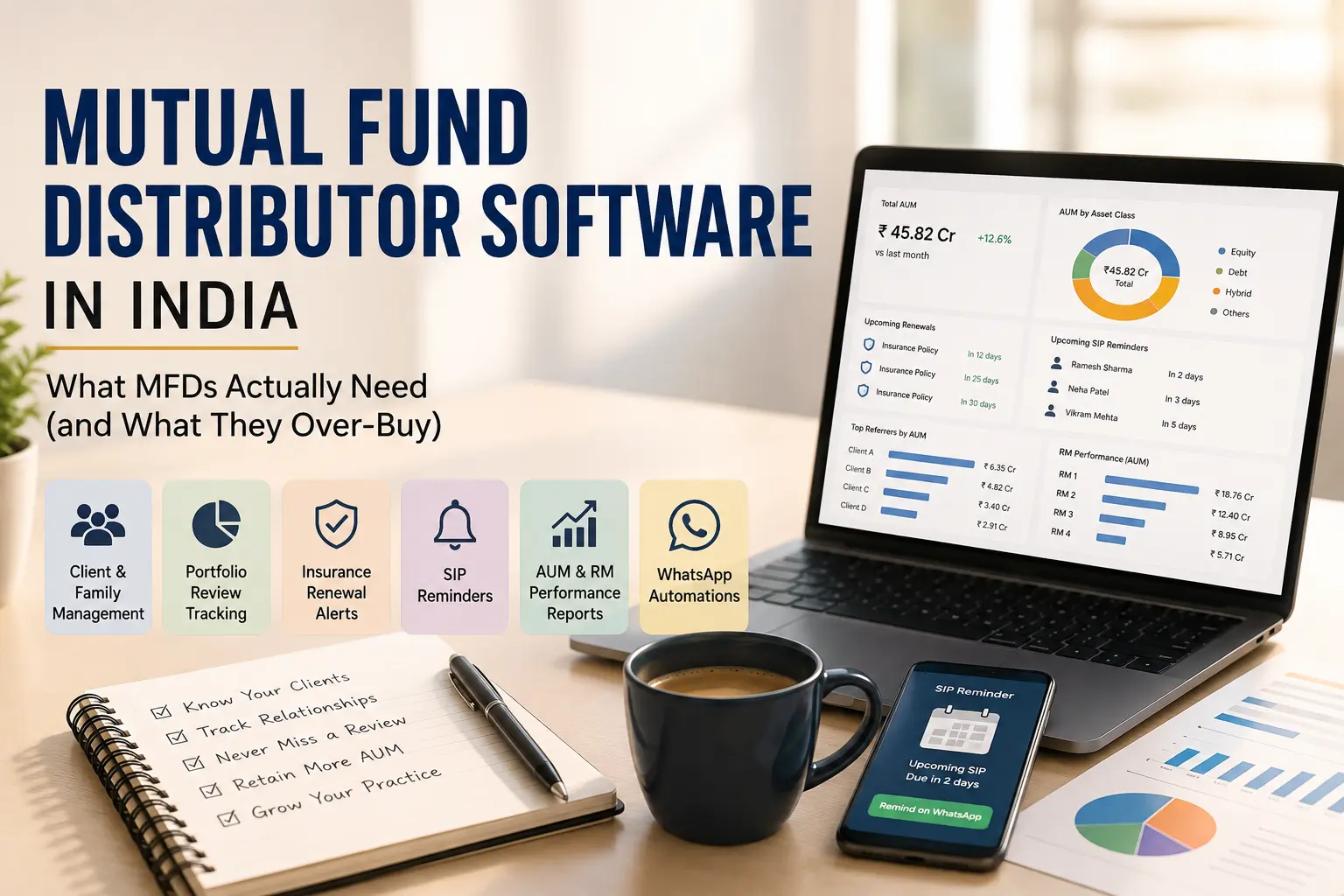
Mutual Fund Distributor Software in India: What MFDs Actually Need (and What They Over-Buy)
Four Questions Most Distributors Can’t Answer
Before anything about software, try these. No looking anything up.
- Which referrer has brought you the most AUM in the last three years?
- Which of your HNI clients hasn’t had a portfolio review in the last four months?
- Whose insurance policies expire in the next thirty days?
- Which of your clients hold mutual funds with you and nothing else?
Most MFDs can’t answer any of the four. Not from disorganisation — most distributors we work with are meticulous people. The information simply lives in four different places: a portfolio tool, a WhatsApp history, an Excel file, and memory. Nothing joins them up.
Each of those questions is worth money. The first tells you who your actual distribution channel is. The second is your attrition risk. The third is renewal revenue you’re about to lose to whoever calls first. The fourth is your cross-sell list.
That gap is what mutual fund distributor software is for. Not tasks and reminders — that’s the generic version, and distributors are right to dismiss it.
The Three Categories People Confuse
Most confusion in this market comes from three different product types sharing overlapping vocabulary. Getting this straight makes every vendor conversation shorter.
| Category | What it does | What it doesn’t |
|---|---|---|
| Transaction platforms | Execute purchases, redemptions, switches; NSE/BSE order routing | Manage relationships, remind you of anything, track referrals |
| Portfolio software | Folios, valuation, NAV, returns, capital gains, client statements | Tell you who to call, when a policy expires, or who referred whom |
| Practice management / MFD CRM | Families, referrals, review cycles, insurance renewals, SIP reminders, interaction history, cross-sell gaps | Execute transactions or calculate returns |
You almost certainly need the first two already. The question is whether the third is a gap in your practice — and the four questions above are the test.
Be sceptical of any vendor claiming one product does all three exceptionally well. They’re different engineering problems, and depth in one usually means shallowness in the others.
Why a Generic CRM Doesn’t Fit an MFD Practice
The mismatch isn’t missing features. It’s that a generic CRM makes four assumptions about your business that are simply wrong.
It assumes you sell to individuals. You serve families. Your client is a husband, a wife, two children, sometimes an HUF, sometimes a parent. Money moves between them, decisions get made jointly, and a conversation with the wife is a conversation with the client. A CRM that stores five disconnected contacts shows you five records and no household.
It assumes leads come from campaigns. Yours come from people. Generic lead sources are Google Ads, website form, trade show. Yours is a name — an existing client who sent his brother-in-law. Filing all of them under “referral” as one source throws away the most valuable data in your business.
It assumes a sales cycle that ends. Yours never does. Generic CRM is built to move a deal to closed-won. Your relationship starts at the first SIP and runs twenty years, through reviews, top-ups, redemptions, renewals, education goals and retirement. The most valuable work happens years after the “deal” closed.
It assumes you’re chasing new business. You’re mostly servicing existing business. Much of your growth comes from existing clients increasing SIPs, adding products and referring others. Software optimised for pipeline velocity solves a bottleneck you don’t have.
What Mutual Fund Distributor Software Should Actually Do
Everything below exists in Sanchay CRM, which is built specifically for mutual fund distributors in India. Each item is here because distributors asked for it, not because it looked good on a feature list.
1. Referral Tracking With AUM Attribution
The single biggest gap between generic CRM and real MFD software.
Most of your new clients arrive through referrals. What you almost certainly cannot produce is a report showing which client referred how many people, and how much AUM came through each of them.
Capture the referrer on every lead and that report exists. It changes decisions:
- You discover four clients account for most of your referral-driven AUM — and you’ve been treating them like everyone else
- You see which referrers send business that converts, versus names that never respond
- You know who deserves a review meeting, a Diwali gift, or a call that isn’t about money
Nothing about this is technically hard. It doesn’t happen because generic CRM has one field called “source” and it says “referral.”
2. Portfolio Review Meetings on Autopilot
Every distributor knows reviews matter. Every distributor’s review schedule drifts. Not from negligence — because tracking that eleven HNI clients need monthly reviews and sixty others need quarterly ones isn’t something a human does reliably alongside everything else.
Category-based recurrence solves it. Define the frequency per client category — monthly for HNI, quarterly, half-yearly or annual for others — set the start date once, and the next meeting generates automatically as soon as the previous one is marked complete.
You stop maintaining a schedule. The schedule maintains itself.
The commercial effect is direct: clients who get regular reviews increase SIPs, add products and refer more. Clients untouched for eight months are the ones who move to a bank RM who called them.
3. Insurance Tracking and Renewal
Most MFDs distribute insurance and track it far worse than they track funds. Policy documents sit in email, renewal dates live in memory, and the reminder arrives from the insurer — by which point someone else has already called your client.
The full cycle should be covered:
- Upload the policy PDF and the record creates itself. The system reads the document and populates policy details, editable if anything needs correcting. No manual entry across dozens of policies.
- Renewal tasks generate automatically at whatever lead time suits you — thirty days ahead, sixty, your choice.
- One-click renewal carries existing data into the new record, editable where things changed.
- Policy history stays attached, so you see the full arc of a client’s cover.
- Claim tracking, because the claim is when your client finds out whether you were worth having.
Insurance renewal is recurring, high-margin revenue that distributors partially lose every single year purely because nobody was reminded in time.
4. SIP Reminders on WhatsApp
A bounced SIP is a small problem that becomes a large one. The instalment fails, nobody notices for a month, and by the time it surfaces the client has lost compounding and you’ve had an awkward conversation.
SIP data sits in the system and reminders go out ahead of the debit date over WhatsApp or email, at any mandate frequency. Your clients read WhatsApp. They don’t read email. That’s not a preference, it’s how India works, and software that ignores it sends reminders nobody sees.
5. Last Interaction, Across the Whole Family
One screen answering one question: when did anyone on my team last speak to this client, and about what?
Calls, emails, WhatsApp, SMS and tasks logged against both the client and the family group. So you can see you last spoke to Mr Shah in March, but your RM spoke to Mrs Shah in June about their daughter’s education plan — context you’d otherwise walk into a meeting without.
The practical use is a filter: show me every client with no contact in ninety days. That list is your quiet attrition, and it’s invisible without this.
6. Cross-Sell and Up-Sell From Product Gaps
You know what your clients hold. Harder to see is what they don’t.
Map holdings per client and the gaps become a list instead of a hunch. Clients with SIPs but no insurance. Clients with insurance but no ELSS. Clients whose SIP hasn’t changed in four years despite a salary that has.
You walk into the review knowing which conversation to have, rather than asking generally whether they’d like to invest more. Same meeting, entirely different outcome.
7. Birthdays and Anniversaries
Smallest feature here, and disproportionately effective. Automated greetings to clients and their family members.
Costs nothing, takes no time, and it’s a touchpoint that isn’t about money — which in a relationship business is worth more than one that is.
8. Knowing What Your RMs Did Today
If you have relationship managers, you’re managing work you can’t observe. Activity tracking shows calls made, meetings held and tasks completed per RM, with performance reporting on top.
Not surveillance — the point is telling the difference between an RM who’s genuinely busy and one who’s busy-looking, and knowing who can handle more clients before you hire.
9. Custom Reports You Can Schedule
Every practice measures something slightly different. AUM by category, AUM by referrer, SIP book by RM, renewals due next quarter, clients untouched in ninety days.
A custom report builder matters more than any pre-built report, because the useful question is always the one you thought of last week. Scheduling matters too — a report arriving in your inbox every Monday gets read; one you must remember to generate does not.
Two Versions: Which One Are You?
A distinction worth understanding before you evaluate anything, because it decides which conversation you should be having.
Solo distributors. If you’re running the practice yourself — no RMs, no operations person, often no office — your constraint isn’t team coordination. It’s that you’re out all day. Client meetings, society visits, a bank branch, someone’s home in the evening. You aren’t sitting at a desk waiting to update records, and any software that assumes you are will be updated on Sunday night from memory, which produces fiction.
This is what Sanchay One is for. Same platform, built around the assumption that your primary device is your phone. Client records, SIP details, insurance policies, review meetings, referrals, interaction logging — all of it usable from the mobile app while you’re standing outside a client’s building, not typed up later from a notebook. Desktop access is there when you want it, but it isn’t where the work happens.
Practices with a team. Once you have relationship managers, an operations person, or a growing client base split across people, your problems change. Now you need to know what your RMs did today, who owns which family, and whether the review someone promised actually happened. That’s the fuller Sanchay CRM configuration.
Both run on the same mobile app, available on Android and iOS, so a distributor who starts solo and later adds a team isn’t migrating to a different product — the practice grows and the software follows.
The practical read: solo doesn’t mean too small. A solo MFD managing 150 families across SIPs, insurance and review cycles has exactly the same memory problem as a five-person practice — arguably worse, because there’s nobody to cover for what gets forgotten. What changes is the interface you need, not whether you need one.
Can You Just Use Zoho or Salesforce?
A fair question, and the honest answer is: yes, technically, with real caveats.
Zoho CRM in particular is highly customisable. With enough custom fields, modules, workflow rules and effort, you can build family grouping, referral attribution and renewal reminders. Some distributors have done exactly that, and some Zoho partners will build it for you.
Three things to weigh before going that route.
You’re building the MFD logic, and you own it forever. The custom fields, the automation rules, the report templates — that’s your configuration to maintain. When the person who built it leaves, or when you want to change review frequencies across client categories, you’re back in the builder. Purpose-built software ships with that logic already made and maintained by someone else.
The India-specific pieces need separate work. WhatsApp reminders, policy PDF extraction, family-level interaction history spanning SMS and calls — these are typically connectors, custom development, or simply absent. Each one is a cost and a dependency.
Total cost is rarely lower. Licence plus customisation plus a partner to build it plus ongoing changes usually lands above a purpose-built product, and you’ve spent three months getting there.
Where a generic platform genuinely wins: if you already run Zoho or Salesforce across a larger business and want everything in one place, or if you have internal technical capacity and enjoy owning the configuration. Those are legitimate reasons. “It’s cheaper” usually isn’t, once you count properly.
What About Free Software?
People search for free mutual fund distributor software, so let’s address it straight.
Free tiers of general CRMs exist and are genuinely useful for one purpose: testing whether you and your team will log data at all. If you can’t sustain the habit for six weeks on a free tool, paying won’t fix that — and you’ve learned something valuable for nothing.
What free won’t give you is the MFD-specific layer. Referral AUM attribution, category-based review cycles, insurance renewal automation, family grouping — none of this appears in free tiers, because building it is the expensive part.
The trap is the migration cost. Free works fine at eighty clients. At three hundred, with two RMs and four years of interaction history, moving becomes a project you’ll undertake at the worst possible moment. If you’re already past a hundred clients, start where you intend to stay.
The Compliance Question Nobody Plans For
Distributors consistently underestimate this until it’s urgent.
Your practice runs on advice, and advice is increasingly expected to be documented. If you’re asked to demonstrate how you serviced a particular client — what was recommended, when, what they were told, how often the portfolio was reviewed — what can you actually produce?
For most distributors the honest answer is a WhatsApp history on a personal phone, some emails, and memory. That isn’t a record. It’s a hope that nobody asks.
When every call, email, WhatsApp message, SMS and task is logged against the client and the family, you have a complete interaction history you can export as a report. Whether for a regulatory query, a client dispute, or handing a relationship to a new RM, the evidence exists.
To be clear about limits: software maintains records, it doesn’t make you compliant, and this isn’t regulatory advice. Your obligations are yours. But the practical difference between producing a client servicing history in ten minutes versus reconstructing it from a personal phone is significant, and costs nothing to be on the right side of.
Evaluation Checklist
Take this to any demo. Ask vendors to show each row, not confirm it.
| Requirement | What to look for |
|---|---|
| Family structure | Family groups with linked members, not isolated contacts |
| Referral management | Referrer captured per lead, AUM attributed back by referrer |
| Review meetings | Category-based recurrence, next meeting auto-created on completion |
| Insurance | PDF upload with data extraction, renewal tasks at chosen lead time, one-click renewal, policy history, claim tracking |
| SIP | Reminders before debit date over WhatsApp and email, any frequency |
| Interaction history | Call, email, WhatsApp, SMS and task at client and family level |
| Last interaction view | Filter clients by time since last contact |
| Cross-sell | Product holding gaps visible per client |
| Client touchpoints | Automated birthday and anniversary greetings |
| Team management | RM activity tracking and performance reporting |
| Reporting | Custom report builder with scheduled delivery |
| Evidence | Exportable client servicing history across all channels |
Who This Fits — and Who It Doesn’t
Good fit if you are:
- A solo MFD working mostly in the field, needing client records, SIPs, policies and review meetings accessible from your phone rather than a desk
- An MFD or IFA past roughly a hundred families, where memory has stopped being sufficient
- Running RMs whose daily work you can’t directly observe
- Distributing insurance alongside funds and tracking renewals informally
- Growing through referrals without measuring which referrers matter
- Finding review meetings slip for months without anyone noticing
- Planning to eventually sell or transition the practice, where documented relationships are the asset
Probably not the right fit if you are:
- Just starting out with a handful of clients and no SIP book yet — build the practice first, the software follows
- Looking for portfolio analytics, NAV tracking or return calculation — different category, as covered above
- Looking for transaction execution — that’s your platform, not this
- Unwilling to load existing client, SIP and policy data properly, since value is proportional to how complete that data is
What Implementation Actually Involves
The software is rarely why these projects fail.
Get client and family data in properly. Unglamorous, and it decides everything. Family linkages, existing SIPs, current policies with renewal dates. A half-loaded system produces half-useful reports and the team stops trusting it.
Define client categories before configuring review cycles. Who’s monthly, quarterly, half-yearly, annual. That’s a business decision, not a software setting, and it deserves an hour of real thought rather than defaulting everyone to quarterly.
Start with one thing. Review meeting automation first — fastest visible return, least resistance. Insurance and referral tracking second. SIP reminders and reporting third.
Name who owns data entry. If it’s ambiguous it won’t happen. Usually the RM logs interactions and an operations person maintains policy and SIP records. Whatever your arrangement, say it out loud.
Stop keeping the parallel Excel. Practices that run both systems “for safety” end up trusting neither. Pick a date and move.
Frequently Asked Questions
What is mutual fund distributor software?
Practice management software for MFDs and IFAs covering client and family records, referral tracking, portfolio review scheduling, insurance renewals, SIP reminders, interaction history and reporting. Distinct from portfolio software, which handles folios, NAV and returns, and from transaction platforms, which execute purchases and redemptions.
Which is the best software for mutual fund distributors in India?
There isn’t one answer, and any article claiming otherwise is selling something. The right choice depends on whether your gap is relationship management, portfolio analytics or transaction execution — three different categories. Start with the four questions at the top of this article. If you can’t answer them, your gap is practice management, and that narrows the field considerably.
How is this different from a normal CRM?
A generic CRM assumes individual contacts, campaign-driven leads and a sales cycle that ends at closure. An MFD serves families, grows through named referrers, and does the most valuable work years after the first investment. MFD software is built around family grouping, referral attribution, recurring review cycles and renewal tracking.
Can I use Zoho CRM for a mutual fund distribution business?
Technically yes, with customisation. Zoho is flexible and some distributors have built family grouping and referral tracking on it. The trade-offs are that you own and maintain that configuration permanently, India-specific pieces like WhatsApp reminders and policy PDF extraction usually need separate work, and total cost after customisation and partner fees is often higher than purpose-built software rather than lower.
Is there free mutual fund distributor software?
Free tiers of general CRMs exist and are useful for testing whether your team will log data consistently. They won’t include the MFD-specific layer — referral AUM attribution, category-based review cycles, insurance renewal automation — because that’s the expensive part to build. The real cost of free is migration later, at whatever moment turns out to be least convenient.
Can I track how much AUM has come through each referrer?
Yes, provided referrals are captured with their source at entry. This is one of the clearest gaps between generic CRM and MFD-specific software, and it usually surfaces a concentration distributors hadn’t seen — a small number of clients driving most referral-led growth.
Does it handle insurance as well as mutual funds?
It should. Look for policy PDF upload with automatic data extraction, renewal tasks at a lead time you choose, one-click renewal carrying data forward, policy history and claim tracking. Insurance renewal is recurring revenue distributors routinely lose to whoever reminds the client first.
Will it replace my portfolio or transaction software?
No, and be cautious of vendors suggesting otherwise. Portfolio software handles folios, valuation and returns. Transaction platforms execute. MFD practice management software manages who your clients are, what they hold, when you last spoke, what’s due for renewal, and what to discuss next.
How does portfolio review meeting automation work?
Assign a review frequency per client category — monthly for HNI, quarterly or half-yearly for others — and set a start date. When one review is marked complete, the next generates automatically at the right interval. You stop maintaining the schedule manually, which is exactly where review discipline usually breaks.
Can I send SIP reminders on WhatsApp?
Yes. SIP details sit in the system and reminders go out before the debit date over WhatsApp or email at whatever lead time you set, for any mandate frequency.
Is this useful for a solo MFD?
Yes, and there’s a version built specifically for it. Sanchay One is designed around solo distributors who work in the field rather than from an office — everything usable from the mobile app, so records get updated at the client’s doorstep instead of reconstructed on Sunday night. Solo doesn’t mean small: a distributor managing 150 families alone has the same memory problem as a team, with nobody to cover the gaps.
Which version should a solo distributor choose?
Sanchay One if you’re managing the practice yourself, particularly if most of your day is spent visiting clients rather than sitting at a desk. The fuller configuration makes sense once you add relationship managers or an operations person, because then you need RM activity tracking and clear ownership of families. Both run on the same mobile app for Android and iOS, so moving from one to the other as the practice grows isn’t a migration.
Is there a mobile app?
Yes, on both Android and iOS. This matters more than it sounds for MFDs, since most of the work happens away from a desk — a client’s home, a society office, a bank branch. Software that’s only practical on a laptop gets updated from memory later, and memory is where the details go missing.
What about SEBI and AMFI record-keeping?
Software maintains records; it doesn’t make you compliant, and this isn’t regulatory advice. What it provides is a complete, exportable history of every call, email, WhatsApp message, SMS and task per client and family. If you’re asked to demonstrate how a client was serviced, having that in minutes rather than reconstructing it from a phone is a material difference.
How long does implementation take?
A first phase covering client and family data plus review meeting automation typically goes live in a few weeks. Adding insurance, SIP and referral history extends it — mostly data preparation rather than configuration.
What does it cost?
Generally quoted on request based on user count and modules. Establish the total during evaluation — licence, implementation, data migration, training and ongoing support — since comparing a bundled quote against an unbundled one is how buyers get surprised later.
Conclusion
Most MFDs dismiss this category because they’ve only seen the generic version — tasks, leads, a calendar — and correctly concluded they don’t need it.
What they haven’t seen is software that understands the actual shape of a distribution practice. That clients arrive in families, not as individuals. That referrers are a distribution channel worth measuring. That a review cycle is not a sales pipeline. That insurance renewal is revenue you lose by forgetting rather than by losing. That the most valuable conversation available to you this month is with a client whose SIP hasn’t increased in four years — and you have no way of knowing to have it.
Go back to the four questions. Which referrer brought the most AUM. Which HNI client hasn’t been reviewed in four months. Whose policy expires in thirty days. Who holds funds with you and nothing else.
They aren’t software questions. They’re business questions, every one of them worth money. Good mutual fund distributor software just means you can answer them on a Tuesday afternoon without calling anybody.
Technofet is a certified implementation partner for Sanchay CRM, built specifically for mutual fund distributors and IFAs in India, with 65+ CRM implementations delivered. If you’d like to see how this maps to your practice — your client categories, review cycles and referral structure — book a discovery call and we’ll walk through your workflow before showing you a single screen.